A few weeks ago, I had an uninterrupted block of writing time, an elusive four hours writers dream of and rarely get. At work on my first book, a sociopolitical narrative with hefty themes of structural racism, xenophobia, and other institutional inequities that plagued my country, I was knee-deep in a chapter reflecting on the tumultuous events of 2020. While I was tempted to get up after about an hour and a half, I leaned back and thought of the pianist Yuja Wang. I had just seen her perform in San Francisco the weekend prior, and her striking performance was still fresh in my mind. “Yuja wouldn’t get up right now. She’d finish,” I said aloud as I forced myself to stay seated. My soul knew I wasn’t done and drew on the memory of my favorite pianist sitting on stage to motivate me.
On that glorious February evening, Yuja began her highly anticipated performance with Maurice Ravel’s “Piano Concerto in D major for the Left Hand.” Reading about Ravel’s reasons for writing the piece, I was led to the story of pianist Paul Wittgenstein. The Austrian-born artist’s body was ravaged by a battlefield injury during World War I, resulting in the amputation of his right arm. Marked with the permanent trauma of war, Wittgenstein commissioned left-hand pieces from various composers, including Ravel. With multiple wars raging around the world and my own country on the brink of a civil one, I thought of the repercussions of political greed and the deep wounds they leave not only on the physical body but on the psyche of a nation.
This challenging composition calls the body to channel its power through the left hand, and Yuja Wang executed it exquisitely. As she leaned to the left, her right arm gripping the piano bench, Yuja swayed and stormed with each crescendo. Having briefly studied the psychology of phantom limbs, I wondered how she trained mentally, as well as physically, to perform this piece so flawlessly. Knowing that the psychological and physiological effects of amputation can last a lifetime, I thought of the countless war veterans like Wittgenstein who had to overcome their mental anguish of what was missing while filling that space with compulsive hope.
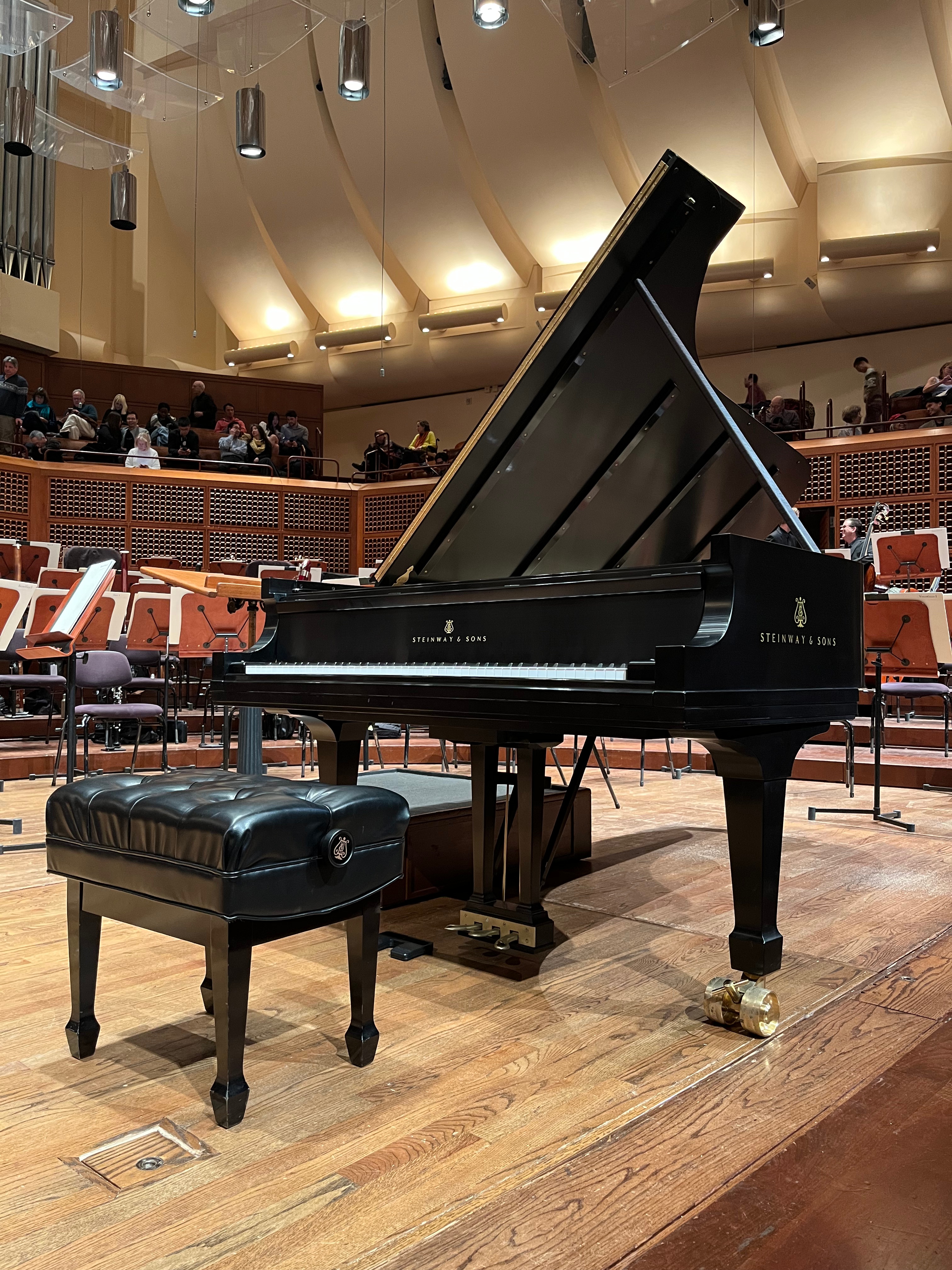
Just a year ago, in this same concert hall, I saw Yuja perform to a sold-out crowd and was a few tiers away from her greatness. She gave us the performance of a lifetime with what felt like endless encores; each one met with a rousing applause that increased with intensity and volume of enthusiastic shouts and screams from the crowd. Was this even humanly possible? I thought as I lost count of what pieces she played, watching while she shook off her arms and shoulders as if going back into a boxing ring for another round. This time, I had the luxury of sitting up close, so I did as the other eager fans did – I walked over and quickly snapped a photo of the piano and bench where we had all witnessed her brilliance on the keys.
While playing for an enraptured crowd on Valentine’s Day, Yuja gave us the ultimate gift that night. She stepped out onto the stage wrapped in sumptuous silk stained a shocking shade of strawberry red that draped around her leg in a loose bow, only to be caught by a cascading panel of crystalline gems down her back, reminiscent of her twinkling fingers across the keys. She was very Venusian in her vibe – a tribute to Friday’s namesake and the goddess of love – she was our sweetheart. I realized in that moment that I came for the collective experience of a live performance – the sighs and gasps of those seated next to you – reminders that we were alive and living in a shared moment. As she sat down, her dress draped in a dramatic vision. Dramatic – like her performance. Up close, it was exhilarating, and as I watched the muscles in her back move with the stroke of the keys, I was captivated by her genius once again. Her fascinated fans were drawn further under her spell as Yuja seduced us with a second concerto. With each note of Finnish composer Einojuhani Rautavaara’s Piano Concerto No. 1, Opus 45, Yuja moved us through a bold opener to a subtly haunting second movement and ultimately closed with a roaring finish. Almost matched by the passionate roar of the crowd, Yuja reminded us why she is considered one of the greatest pianists of our time. Rautavaara’s intent to “restore the entire rich grandeur of the instrument” with this piano concerto proved true on February 14, 2025.
Yuja graced us with a few encores, including Sibelius’ Etude Op. 76 No. 2, perhaps a collegial nod to Esa-Pekka Salonen, our esteemed conductor for that magnificent evening. She plays with the greatest conductors in concert halls around the globe, where her performances have been known to sell out in under an hour. Her playing is incredibly vast; her range is so wide that the divine spark that comes through her is what people are going to see. The spectacle of her daring dresses is an unexpected delight for our sense of sight. Young and old alike comment on what she’ll wear: the ushers at the door of the symphony hall, excited fans bustling at the entrance, and the animated attendant working at the coat check. We all know she’s going to play an exceptional program of music; that’s a given. What we don’t know is her wardrobe choice and what dazzling ensemble she’ll wear for her fans. Yuja gave the genre of classical music something that it didn’t know it needed – charm and seductive sassiness that a new generation of fans was waiting to embrace.
As audiences around the world embrace her, Yuja continually impresses us with her art, with her craft, and the magnificence of her piano performances. She doesn’t get up. She doesn’t take a break. That’s what it takes to create magic.

